
Introduction
771.0 is a casting grade in the Aluminum-Zinc Alloy family, specified in ASTM B26/B26M. The specification defines its chemical composition and mechanical requirements for the applicable sand-casting tempers. Casting process options include Sand Casting, subject to the applicable specification and component requirements.
| Field | Value |
|---|---|
| Designation | 771.0 |
| Material Type | Aluminum Alloy |
| Sub Type | Aluminum-Zinc Alloy |
| Product Form | casting |
Manufacturing Process
Sand Casting
Equivalent Grades
N/A
Similar Materials
N/A
Reference Standards
| Standard | Standard Title | Edition | Specification | Identifier |
|---|---|---|---|---|
| ASTM B26/B26M | Standard Specification for Aluminum-Alloy Sand Castings | 05 | 771.0 | UNS A07710 |
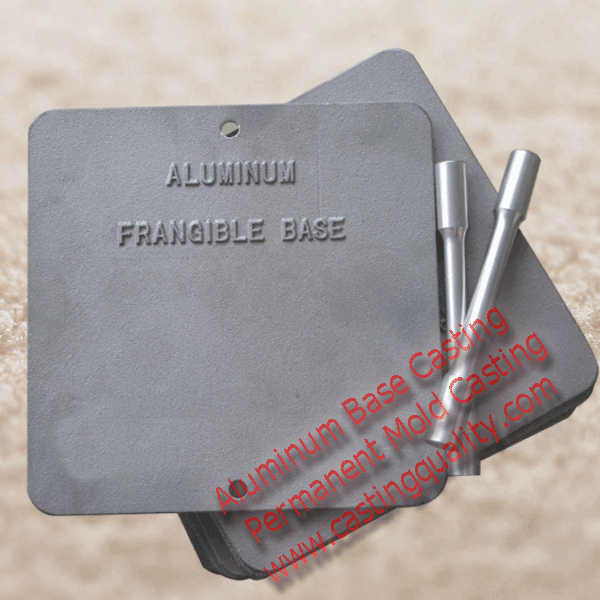
Related Casting Products


Physical Properties
N/A
Chemical Composition
| Element | ASTM B26/B26MEdition 05 · wt.% |
|---|---|
| Si | ≤ 0.15 |
| Fe | ≤ 0.15 |
| Cu | ≤ 0.10 |
| Mn | ≤ 0.10 |
| Mg | 0.8–1.0 |
| Cr | 0.06–0.20 |
| Zn | 6.5–7.5 |
| Ti | 0.10–0.20 |
| Al | remainder |
Notes
ASTM B26/B26M · Edition 05
[1] Chemical composition: Other elements, each: ≤ 0.05 wt.%
[2] Chemical composition: Other elements, total: ≤ 0.15 wt.%
Heat Treatment
ASTM B26/B26M–05 · Sand Casting · T5 · Recommended heat treatment
| Step | Operation | Temperature / holding time | Cooling |
|---|---|---|---|
| 1 | Recommended: Precipitation heat treatment | 355 °F / 180 °C; Holding time: 3–5 h[1] | Still air outside furnace |
ASTM B26/B26M–05 · Sand Casting · T51 · Recommended heat treatment
| Step | Operation | Temperature / holding time | Cooling |
|---|---|---|---|
| 1 | Recommended: Precipitation heat treatment | 405 °F / 205 °C; Holding time: 6 h[2] | Still air outside furnace |
ASTM B26/B26M–05 · Sand Casting · T52 · Recommended heat treatment
| Step | Operation | Temperature / holding time | Cooling |
|---|---|---|---|
| 1 | Recommended: Precipitation heat treatment | 330 °F / 165 °C; Holding time: 6–16 h[3] | Still air outside furnace |
ASTM B26/B26M–05 · Sand Casting · T6 · Recommended heat treatment
ASTM B26/B26M–05 · Sand Casting · T71 · Recommended heat treatment
Notes
ASTM B26/B26M · Edition 05
[1] T5, T5 · Recommended heat treatment: Source: ASTM B917/B917M–25 (Recommended; when specified by the material specification or purchase order).; ±10°F; Use suitable metal-temperature measurement; sections/microstructure affect soak time selection (7.2).; No quenching required. Cool in still air outside the furnace.; ±5°C
[2] T5, T51, T51 · Recommended heat treatment: Source: ASTM B917/B917M–25 (Recommended; when specified by the material specification or purchase order).; ±10°F; Use suitable metal-temperature measurement; sections/microstructure affect soak time selection (7.2).; No quenching required. Cool in still air outside the furnace.; ±5°C
[3] T5, T52, T52 · Recommended heat treatment: Source: ASTM B917/B917M–25 (Recommended; when specified by the material specification or purchase order).; ±10°F; Use suitable metal-temperature measurement; sections/microstructure affect soak time selection (7.2).; Stress relieve for dimensional stability: hold at 775 ± 25°F for 5 h; furnace cool to 650°F for 2 or more h; furnace cool to 450°F for not more than 3/4 h; furnace cool to 250°F for approximately 2 h; cool to room temperature in still air outside the furnace.; Time required depends on variations in cooling rate between 650°F and 450°F during stress-relief procedure (Footnote J).; No quenching required. Cool in still air outside the furnace.; ±5°C; Stress relieve for dimensional stability: hold at 415 ± 15°C for 5 h; furnace cool to 345°C for 2 or more h; furnace cool to 230°C for not more than 3/4 h; furnace cool to 120°C for approximately 2 h; Time required depends on variations in cooling rate between 345°C and 230°C during stress-relief procedure (Footnote J).
[4] T6, T6 · Recommended heat treatment: Source: ASTM B917/B917M–25 (Recommended; when specified by the material specification or purchase order).; ±10°F; Use suitable metal-temperature measurement; sections/microstructure affect soak time selection (7.2).; Quench in water at 150 to 212°F except as noted.; Time at solution temperature may be increased for section thickness over 1 in.; No quenching required. Cool in still air outside the furnace.; ±5°C; Quench in water at 65 to 100°C except as noted.; Time at solution temperature may be increased for section thickness over 25 mm.
[5] T6, T6 · Recommended heat treatment: Source: ASTM B917/B917M–25 (Recommended; when specified by the material specification or purchase order).; ±10°F; Use suitable metal-temperature measurement; sections/microstructure affect soak time selection (7.2).; No quenching required. Cool in still air outside the furnace.; ±5°C
[6] T71, T71 · Recommended heat treatment: Source: ASTM B917/B917M–25 (Recommended; when specified by the material specification or purchase order).; ±10°F; Use suitable metal-temperature measurement; sections/microstructure affect soak time selection (7.2).; Quench in water at 150 to 212°F except as noted.; Time at solution temperature may be increased for section thickness over 1 in.; No quenching required. Cool in still air outside the furnace.; ±5°C; Quench in water at 65 to 100°C except as noted.; Time at solution temperature may be increased for section thickness over 25 mm.
[7] T71, T71 · Recommended heat treatment: Source: ASTM B917/B917M–25 (Recommended; when specified by the material specification or purchase order).; ±10°F; Use suitable metal-temperature measurement; sections/microstructure affect soak time selection (7.2).; No quenching required. Cool in still air outside the furnace.; ±5°C
Mechanical Properties
Conditions are not identical. Compare each stated condition and applicability separately.
| Property | ASTM B26/B26MEdition 05T5 | ASTM B26/B26MEdition 05T51 | ASTM B26/B26MEdition 05T52 | ASTM B26/B26MEdition 05T6 | ASTM B26/B26MEdition 05T71 |
|---|---|---|---|---|---|
| Tensile Strength | ≥ 42.0 ksi / ≥ 290 MPa[1] | ≥ 32.0 ksi / ≥ 220 MPa[2] | ≥ 36.0 ksi / ≥ 250 MPa[3] | ≥ 42.0 ksi / ≥ 290 MPa[4] | ≥ 48.0 ksi / ≥ 330 MPa[5] |
| Yield Strength (Rp0.2) | ≥ 38.0 ksi / ≥ 260 MPa[1] | ≥ 27.0 ksi / ≥ 185 MPa[2] | ≥ 30.0 ksi / ≥ 205 MPa[3] | ≥ 35.0 ksi / ≥ 240 MPa[4] | ≥ 45.0 ksi / ≥ 310 MPa[5] |
| Elongation | ≥ 1.5 %[1] | ≥ 3.0 %[2] | ≥ 1.5 %[3] | ≥ 5.0 %[4] | ≥ 2.0 %[5] |
| Brinell Hardness | 100 HB[6] | 85 HB[7] | 85 HB[8] | 90 HB[9] | 120 HB[10] |
Notes
ASTM B26/B26M · Edition 05
[1] Tensile Strength/Yield Strength (Rp0.2)/Elongation; T5: inch-pound; 2 in. or 4 x diameter / SI; 5 x diameter
[2] Tensile Strength/Yield Strength (Rp0.2)/Elongation; T51: inch-pound; 2 in. or 4 x diameter / SI; 5 x diameter
[3] Tensile Strength/Yield Strength (Rp0.2)/Elongation; T52: inch-pound; 2 in. or 4 x diameter / SI; 5 x diameter
[4] Tensile Strength/Yield Strength (Rp0.2)/Elongation; T6: inch-pound; 2 in. or 4 x diameter / SI; 5 x diameter
[5] Tensile Strength/Yield Strength (Rp0.2)/Elongation; T71: inch-pound; 2 in. or 4 x diameter / SI; 5 x diameter
[6] Brinell Hardness; T5: inch-pound; 2 in. or 4 x diameter; 500 kgf; 10 mm; Typical hardness is for information only, not required for acceptance / SI; 5 x diameter; Typical hardness is for information only, not required for acceptance
[7] Brinell Hardness; T51: inch-pound; 2 in. or 4 x diameter; 500 kgf; 10 mm; Typical hardness is for information only, not required for acceptance / SI; 5 x diameter; Typical hardness is for information only, not required for acceptance
[8] Brinell Hardness; T52: inch-pound; 2 in. or 4 x diameter; 500 kgf; 10 mm; Typical hardness is for information only, not required for acceptance / SI; 5 x diameter; Typical hardness is for information only, not required for acceptance
[9] Brinell Hardness; T6: inch-pound; 2 in. or 4 x diameter; 500 kgf; 10 mm; Typical hardness is for information only, not required for acceptance / SI; 5 x diameter; Typical hardness is for information only, not required for acceptance
[10] Brinell Hardness; T71: inch-pound; 2 in. or 4 x diameter; 500 kgf; 10 mm; Typical hardness is for information only, not required for acceptance / SI; 5 x diameter; Typical hardness is for information only, not required for acceptance
Welding Conditions
N/A
Applications
At the material-family level, typical applications include custom, shaped aluminum sand-cast components for non-aerospace use. ASTM B26/B26M excludes aerospace applications; suitability of this grade must be checked against the component requirements and specified temper.
Last Updated: October 13, 2026